








A critical design decision in any Antibody-Oligo Conjugate workflow is how the oligonucleotide is chemically attached to the antibody. The choice of conjugation chemistry directly affects conjugate stability, stoichiometry, antigen binding, and downstream assay performance.
Below we discuss the most widely used antibody-oligo conjugation strategies and their key advantages and limitations.
Conjugation Chemistry Matters
The conjugation chemistry used to generate antibody-oligonucleotide conjugates plays a critical role in determining assay performance, data quality, and reproducibility. An ideal conjugation strategy would:
- Preserve antibody affinity and specificity by avoiding modification of the antigen-binding (Fab) regions and minimizing structural perturbation of the antibody
- Provide controlled oligo-to-antibody ratios to ensure that signal intensity reflects true target abundance rather than variability in labeling density
- Remain stable under assay conditions including tissue fixation, hybridization, amplification, and washing steps commonly used in spatial and sequencing-based workflows
- Be reproducible and scalable enabling consistent conjugate preparation across batches, antibody panels, and experiments, from early research through large-scale studies
In practice, no single chemistry perfectly satisfies all of these criteria. Simpler approaches often sacrifice site control and conjugate homogeneity, while more precise, site-specific methods can introduce additional complexity, cost, or workflow constraints. As a result, the most appropriate conjugation strategy is typically application-dependent, balancing ease of use, performance requirements, and downstream assay demands.
A Comparison of Antibody-Oligonucleotide Conjugation Chemistries
| Conjugation chemistry | Mechanism | Advantages | Disadvantages |
|---|---|---|---|
| Amine (lysine) coupling | NHS-activated oligos react with primary amines on lysine residues distributed across the antibody surface | Widely available reagents No antibody engineering required |
Heterogeneous products
Risk of blocking antigen-binding regions |
| Thiol (cysteine) coupling | Reduced interchain disulfides or engineered cysteines react with maleimide- or haloacetyl-modified oligos | More site-selective than amines Improved reproducibility Moderate control over stoichiometry |
Requires reduction or engineering
Potential antibody destabilization Maleimide instability in vivo |
| Disulfide re-bridging | Native disulfide bonds are temporarily reduced and re-bridged with bifunctional linkers bearing oligos | Maintains antibody integrity Defined conjugation sites Good batch-to-batch consistency |
Specialized reagents More complex workflows Limited commercial availability |
| Glycan-based conjugation | Fc-region glycans are enzymatically modified to introduce reactive groups for oligo attachment | Highly site-specific Minimal impact on antigen binding Excellent reproducibility |
Time-consuming, multi-step enzymatic process High cost Requires glycosylated antibodies |
| Click chemistry (azide–alkyne) | Antibody and oligo are pre-functionalized with complementary click handles that react selectively | Bioorthogonal Highly efficiency reactions Excellent control over conjugation site |
Requires pre-modification Copper catalysis can damage biomolecules Requirement for high concentrations of antibody and oligo |
| Enzyme-mediated tagging | Short peptide tags on antibodies are enzymatically ligated to oligo-modified substrates | Precise 1:1 stoichiometry Exceptional reproducibility Minimal antibody perturbation |
Requires antibody engineering Proprietary enzymes common Higher development effort |
Selecting the Optimum Conjugation Chemistry
When selecting a conjugation chemistry, consider:
- Is site-specificity essential?
- Do you need speed or scalability?
- Is regulatory or batch consistency critical?
Many assays require quantitative accuracy, reproducibility, and preserved antibody function at single-cell or even subcellular resolution. In these instances, for example with high-plex spatial assays, the trend is moving away from random conjugation and toward precisely controlled, site-specific approaches.
However, despite their advantages, site-specific conjugation methods remain complex and expensive, with most commercial technologies achieving site-specific, covalent attachment only through multi-step and operationally intensive workflows.
oYo-Link®: Eliminating Trade-Offs in Site-Specific Antibody-Oligo Conjugation
To overcome the current challenges of site-specific conjugation, AlphaThera developed oYo-Link® Oligo Custom, a next-generation antibody labeling technology that uses light-activated, site-specific photo-crosslinking chemistry (LASIC) to covalently conjugate oligonucleotides, and other label, to antibodies.
oYo-Link® Oligo Custom reagents enable simple, rapid, site-specific, and covalent conjugation of virtually any off-the-shelf antibody to custom oligonucleotides (ssDNA or dsDNA, ≥80 bp). The workflow consists of just two steps, mix and illuminate, eliminating the need for complex, multi-step protocols.
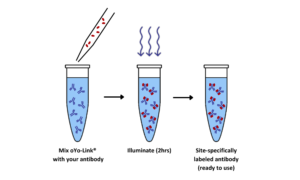
In contrast to enzymatic, glycan-based, or disulfide re-bridging approaches, which often require antibody engineering, extensive sample preparation, or purification steps, oYo-Link® delivers site-specific, covalent conjugation with minimal hands-on time and broad antibody compatibility.
Labeling can be performed at low antibody concentrations (as low as 50 µg/mL) and is compatible with common buffers, including those containing Tris, azide, or BSA. This eliminates the need for prior antibody purification or the purchase of expensive, highly concentrated antibody preparations.
As a result, oYo-Link® provides a cost-effective and streamlined alternative to traditional site-specific conjugation methods.