








Troubleshooting Antibody-Oligo Conjugation
7 Reasons Your Antibody-Oligo Conjugates May be Underperforming
The use of antibody-oligonucleotide conjugates has grown rapidly in recent years, driven by advances in spatial biology, single-cell sequencing, multiplex imaging, immuno-PCR, protein-protein interaction studies, and other highly sensitive molecular assays. The reliance of these applications on DNA-barcoded antibodies to enable highly multiplexed detection and quantitative analysis, is placing increasing demands on conjugation technologies.
Conventional NHS-ester, with amine on lysines, based antibody-oligo conjugation kits have become a popular choice for researchers, offering a straightforward alternative to more technically demanding conjugation methods.
While this chemistry works well for attaching small molecules such as fluorophores, biotin and enzymes, conjugating oligonucleotides can present challenges. Oligos are highly charged, structurally complex molecules that vary in length and architecture. These characteristics can make them difficult to conjugate efficiently using conventional NHS-based approaches.
Antibodies also differ in their sensitivity to conjugation conditions. Some may lose activity, structural integrity or binding performance during the process, meaning NHS-based methods may not be equally well tolerated by every antibody.
As molecular assays continue to evolve and innovate, many applications now require longer, more sophisticated oligos incorporating DNA barcodes, primer binding sites and other functional sequences. These increasing demands expose the limitations of conventional conjugation methods.
Here are seven reasons why your antibody-oligo conjugate may be underperforming when using conventional random labeling conjugation methods and possible solutions to overcome these challenges.
1. Random labeling creates heterogeneous conjugates
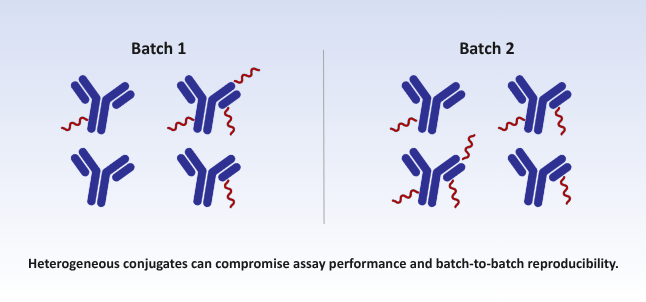
Conventional approaches often attach the oligo to the antibody via lysine residues that are naturally distributed across the antibody surface. Because these lysines are randomly present across each antibody, this can result in a different number of oligos attached at different locations.
What you may observe
The result is a heterogeneous mixture containing unconjugated antibodies, lightly labeled antibodies, and heavily labeled antibodies. This variability can affect assay performance and reduce reproducibility between batches.
How to confirm
Analyze the conjugate using an appropriate characterization method. SDS-PAGE or capillary electrophoresis may show changes in migration after conjugation, while size-exclusion chromatography, ion-exchange chromatography or mass-based analysis can provide more detailed information about conjugate heterogeneity. Measuring the average oligo-antibody ratio (OAR) alone may not reveal whether the sample contains a mixture of unconjugated, lightly labeled and heavily labeled antibodies.
Possible solutions
Optimize the OAR, reaction time and reagent concentration to reduce variability. Alternatively, use a site-specific conjugation method that attaches a defined number of oligos at a controlled location on the antibody.
2. Random attachment can affect antibody performance
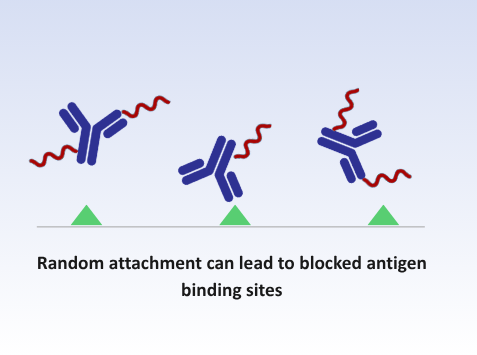
Unlike small molecule labels such as fluorophores or biotin, oligonucleotides are relatively large, highly charged molecules. When they are attached at random locations on an antibody, there is no control over whether the oligo conjugation occurs close to the antigen binding region or other functionally important sites.
What you may observe
If an oligo is attached near the antigen-binding site, its size may physically obstruct access to the target antigen or interfere with antigen recognition. In addition, the presence of a large, negatively charged DNA molecule can alter the local environment around the antibody, potentially affecting binding interactions or the way the antibody behaves in solution. Although binding is not always completely lost, even modest reductions in affinity or accessibility can have a significant impact on assay performance.
For applications that rely on oligo-barcoded antibodies – such as spatial biology, immuno-PCR and multiplex imaging – where sensitive and reproducible target detection is essential, these effects can reduce signal quality, sensitivity and confidence in experimental results.
How to confirm
Compare the binding performance of the conjugated antibody with the corresponding unconjugated antibody using an appropriate assay, such as ELISA, flow cytometry, immunofluorescence or surface plasmon resonance. Include a matched unconjugated-antibody control and, where possible, compare conjugates prepared at different OARs.
Possible solutions
Reduce the extent of labeling and avoid conditions that could damage or destabilize the antibody. If activity remains reduced, use a site-specific approach that positions the oligo away from the antigen-binding region.
Note: Keep in mind that reduced performance does not prove that the oligo has attached near the antigen-binding site; it could also result from aggregation, antibody degradation or assay conditions.
3. Longer and more complex oligonucleotides can present greater conjugation challenges
Many applications now require increasingly complex oligo constructs incorporating molecular barcodes, primer binding sites, amplification sequences and unique molecular identifiers into one oligo sequence.
Compared with shorter DNA tags, longer oligos are bulkier and more likely to fold into secondary structures, such as hairpins, which can reduce the accessibility of the reactive group during conjugation. Their increased size can also make efficient coupling more challenging.
What you may observe
Low conjugation efficiency, a large amount of unconjugated antibody or inconsistent results between oligo sequences.
How to confirm
Compare conjugation using the intended oligo with a shorter or structurally simpler control oligo under the same conditions. Analytical chromatography, electrophoresis or another validated conjugate-characterization method can then be used to compare conjugation efficiency.
Possible solutions
Consider repositioning the reactive modification, adding a spacer between the oligo and reactive group, or redesigning regions predicted to form strong secondary structures where assay requirements allow. Reaction conditions may also be optimized, although these changes must remain compatible with the antibody. A conjugation method designed to accommodate long and structurally complex oligos may provide a more consistent alternative. It is highly recommended to use conjugation methods where there is an affinity between the antibody and oligonucleotide (e.g., photoreactive antibody binding domains such as oYo-Link Conjugation Technology).
4. Controlling the oligo-to-antibody ratio (OAR) is difficult
As multiplexed assays become increasingly sensitive, controlling conjugate composition is becoming more important than ever.
Many downstream applications require OAR to ensure consistent signal intensity and accurate quantification. Because conventional conjugation is often based on random lysine modification, controlling exactly how many oligos become attached to each antibody is challenging.
What you may observe
Variable signal intensity, inconsistent barcode counts or differences in assay performance between conjugation batches.
How to confirm
Measure the OAR across multiple independently prepared batches. UV–visible absorbance may provide an initial estimate, but results can be distorted by residual free oligo and overlapping antibody and nucleic-acid absorbance. Where precise characterization is required, use an orthogonal analytical method capable of distinguishing conjugate populations such as size exclusion chromatography (SEC), Ion Exchange Chromatography (IEX), Capillary Electrophoresis (CE) and SDS-PAGE.
Possible solutions
Maintain tightly controlled reagent concentrations, reaction conditions and purification procedures. Optimizing the input ratio may improve the average OAR, but random conjugation can still produce a mixture of differently labeled antibodies. Use precise purification methods to isolate populations of antibodies with a specific OAR. Site-specific conjugation can provide greater control over both attachment position and OAR.
5. ‘Sticky’ antibodies and residual free oligo can cause non-specific signal or high background
Some antibodies are prone to non-specific interactions or aggregation, while residual unconjugated oligo may remain following conjugation. Both can contribute to increased background and reduce the assay’s signal-to-noise ratio.
What you may observe
High background across the sample, non-specific staining, signal in negative-control samples or a reduced signal-to-noise ratio. Results may also vary between conjugate batches if the amount of residual free oligo or antibody aggregation is inconsistent.
How to confirm
Include appropriate controls to help distinguish between antibody-related background and residual free oligo. These may include the unconjugated antibody, free oligo, the purified conjugate and a no-antibody control under the same assay conditions.
If the unconjugated antibody also produces background, non-specific antibody interactions or aggregation may be responsible. In this case it is recommended to use alternative validated antibodies. Residual free oligo may be assessed using gel or capillary electrophoresis, chromatography, or by analysing purification fractions for nucleic acid content. However, absorbance at 260 nm alone may not reliably distinguish free oligo from antibody-bound oligo.
Possible solutions
Optimizing the assay conditions – for example, by testing alternative buffers or additives- may help reduce non-specific antibody interactions. If residual free oligo is responsible, a more stringent purification method, such as size-exclusion chromatography using an ÄKTA/FPLC system, may be required before using the conjugate in your assay.
6. Multiple purification steps increase sample loss
Traditional NHS-based workflows often require several processing steps, including antibody purification, buffer exchange, oligo activation, removal of excess linker, oligonucleotide coupling and final purification to remove unreacted DNA.
While each step improves product purity, every manipulation also reduces sample recovery.
This cumulative sample loss can become a significant challenge when working with expensive antibodies or custom-synthesized oligonucleotides.
What you may observe
A low final antibody yield, insufficient material for downstream experiments or reduced concentration after successive processing steps.
How to confirm
Measure antibody concentration or total protein recovery before and after each buffer-exchange, activation and purification step. This identifies where the greatest loss occurs. Include suitable controls because residual free oligo and other reaction components can interfere with absorbance-based protein measurements
Possible solutions
Reduce unnecessary purification steps, use low-binding tubes and choose purification devices appropriate for the sample volume and molecular size. Avoid overloading columns or concentrating the sample excessively. Where material is particularly limited, consider a conjugation workflow requiring fewer processing and purification steps.
7. Conventional workflows consume valuable reagents
Custom oligos often represent one of the most expensive components of an experiment due to the high purity requirement.
To compensate for relatively inefficient coupling, conventional conjugation protocols frequently rely on excess amounts of modified oligo and antibody to drive the reaction forward. Unreacted material is subsequently removed during purification, increasing reagent consumption and overall experimental cost.
For laboratories routinely generating DNA-barcoded antibodies, these inefficiencies can quickly become both time-consuming and expensive.
What you may observe
Large quantities of antibody and modified oligo are required during optimization, while much of the unreacted material is discarded during purification.
How to confirm
Record the input quantities of antibody and oligo, the amount recovered as usable conjugate and the number of experimental conditions required during optimization. Comparing input material with final conjugate recovery provides a practical measure of reagent efficiency.
Possible solutions
Maximize the concentration of the reactants to drive more efficient conjugation. Start with small-scale reactions and screen only the most relevant conditions before scaling up. Optimize the process using the smallest practical amount of antibody and oligo, and select a reaction ratio that avoids unnecessary excess.
Alternatively use a conjugation method that requires less antibody to oligo molar ratio of labeling. For example oYo-Link Technology only requires 1: 5, compared with random labeling that often requires 1:20-fold excess of oligo to antibody.
The Case for Site-Specific Antibody-Oligo Conjugation
As DNA-barcoded antibodies become increasingly important for spatial biology, multiplex imaging and other next-generation molecular assays, many researchers are recognizing that conventional conjugation chemistries were not designed to meet the demands of antibody-oligo labeling.
Site-specific conjugation technologies are therefore becoming an increasingly attractive alternative. By attaching oligos at defined locations on the antibody, these approaches can help preserve antigen binding, provide precise control over the oligo-to-antibody ratio, simplify workflows and produce more consistent conjugates for demanding downstream applications.
oYo-Link® Oligo Custom applies this site-specific approach to enable simple, rapid and covalent conjugation of antibodies to custom oligos of virtually any sequence, length or modification.
Conjugation requires just 2 steps, mix oYo-Link Oligo with the antibody and illuminate with non damaging light for 2 hours. There are no oligo and antibody activation steps, no desalting steps, and oYo-Link is compatible with all common buffers, so no antibody purification is required.
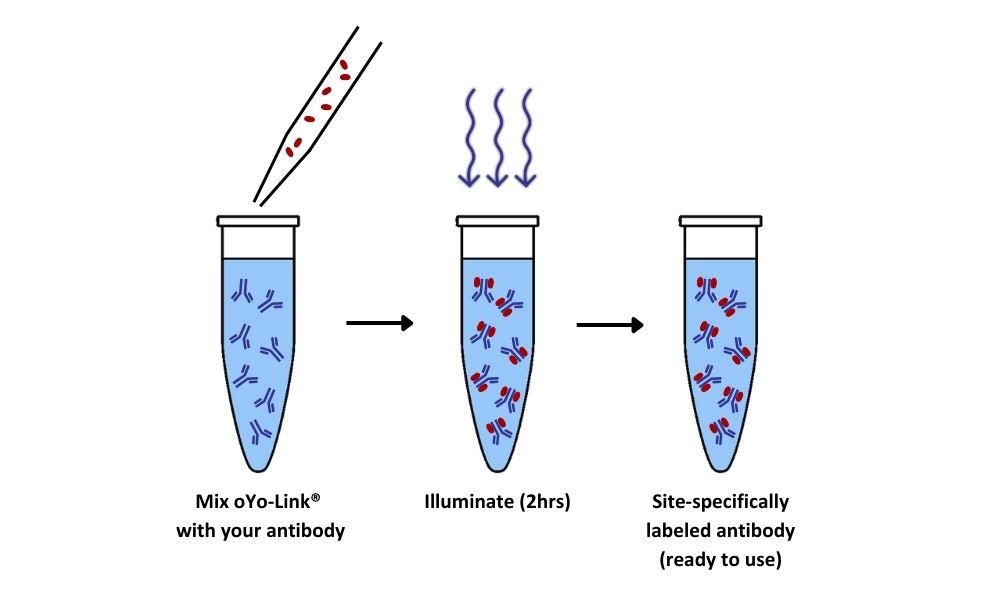
Furthermore, because conjugation occurs site-specifically at the Fc region, the antigen-binding site remains untouched, eliminating the risk of interference with antibody binding.
In addition, the proprietary linker is designed to minimize steric effects, enabling efficient conjugation of even long and structurally complex oligonucleotides.
oYo-Link Oligo Custom also allows conjugation of as little as 1ug of antibody per reaction without the requirement for excess oligo, saving researchers on the cost of expensive reagents.
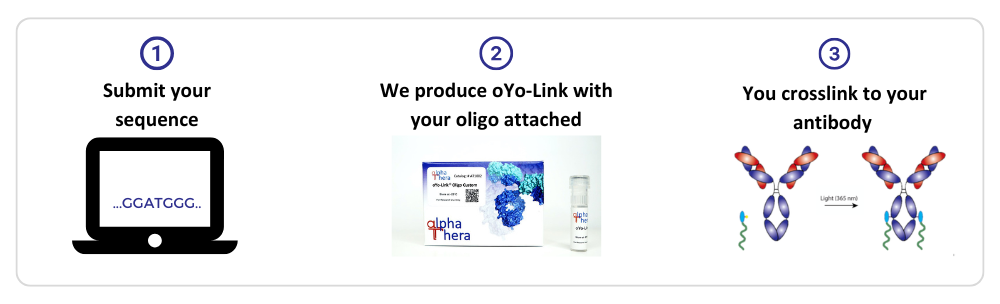
Simply specify your required oligo sequence and modifications, and we’ll source the HPLC-purified oligo on your behalf before supplying your custom oYo-Link® Oligo reagent. The cost of the custom oligo is included in the list price. Conjugation to your antibody is then completed in just two simple steps – mix and illuminate – with approximately 30 seconds of hands-on time.
Discover more about oYo-Link Oligo here, or contact our support team to find out how oYo-Link Oligo Custom can support your project.