




















Antibody conjugates are essential reagents in life science research and biopharmaceutical development, playing a critical role in applications including flow cytometry, spatial biology, IHC single-cell analysis, and antibody-drug conjugate (ADC) development.
Antibody conjugates can be assembled through either covalent or non-covalent approaches. While affinity-based methods remain valuable in certain applications, covalent conjugation offers distinct advantages in terms of conjugate integrity, assay robustness, and reproducibility. Permanent attachment of the label to the antibody reduces the risk of dissociation during complex workflows, supporting more consistent performance and reliable quantitative measurements. As a result, covalent conjugation has become the preferred approach for many advanced analytical and therapeutic applications.
Understanding the Difference
Covalent conjugation involves the formation of a stable chemical bond between the antibody and cargo. Common approaches target lysine residues, reduced cysteines, engineered amino acids, glycans, or photo-reactive Fc-specific binding domains to create a permanent linkage that remains intact throughout storage, handling, and assay execution.
In contrast, non-covalent conjugation relies on reversible molecular interactions such as affinity binding. Examples include biotin-streptavidin systems, antibody-binding domains such as Protein A/G, and secondary antibody-based detection methods.
Although high-affinity non-covalent interactions can exhibit exceptionally strong binding constants, they remain susceptible to dissociation under certain experimental conditions. This fundamental distinction can significantly impact conjugate stability, assay reproducibility, and overall data quality.
In this blog we explore the advantages of covalent conjugation and discuss why researchers developing increasingly complex and quantitative assays are placing greater emphasis on stable, covalently linked antibody conjugates.
Superior Conjugate Stability
One of the primary advantages of covalent conjugation is the formation of a permanent attachment between the antibody and its cargo.
Once formed, covalent conjugates typically remain intact throughout repeated wash steps, extended incubation periods, sample fixation and processing, storage and transport, and exposure to detergents and varying buffer conditions.
In contrast, non-covalent systems may experience partial dissociation during prolonged incubations or under stringent assay conditions, potentially resulting in reduced signal intensity and increased experimental variability.
This enhanced stability is particularly important in applications involving complex sample preparation workflows, such as multiplex immunofluorescence, spatial proteomics, and tissue imaging, where conjugate integrity must be maintained throughout multiple processing steps.
Preserving Signal Intensity and Assay Sensitivity
For many applications, the primary consequence of conjugate instability is the gradual loss of signal throughout the workflow.
Because non-covalent conjugates rely on reversible interactions, partial dissociation can occur during storage, washing, incubation, or sample processing. As the label detaches from the antibody, the number of detectable labels associated with the target decreases, resulting in reduced signal intensity and potentially lower assay sensitivity.
In contrast, covalent conjugation ensures that the cargo remains permanently associated with the antibody throughout the experiment. This helps maintain signal strength, particularly in workflows involving multiple wash steps, extended incubations, or low-abundance targets where every signal molecule is important.
By preserving signal intensity throughout the whole assay, covalent conjugation contributes to improved sensitivity, more reliable quantification, and greater confidence in experimental results.
Improved Reproducibility and Batch-to-Batch Consistency
The stability of covalent antibody conjugates also contributes to improved reproducibility. By minimizing cargo dissociation during storage and assay execution, covalent conjugation reduces a common source of experimental variability, resulting in more consistent signal generation across samples, experiments, and production batches.
For translational research, biomarker discovery, and clinical assay development, reducing technical variability is critical for generating robust and reproducible datasets.
However, while covalent conjugation can significantly improve reproducibility, the degree of consistency achieved is also influenced by how and where the cargo is attached to the antibody. As discussed later in this article, site-specific conjugation technologies can further enhance conjugate uniformity and batch-to-batch consistency.
Reduced Background, Improved Signal-to-Noise Ratios, and Enhanced Multiplexing Performance
Non-covalent conjugates can introduce background signal through the presence of unbound or partially dissociated detection reagents. This challenge becomes even more significant in highly multiplexed workflows, where the accurate assignment of a signal to a specific target is critical.
In multiplexed imaging, spatial biology, and single-cell analysis applications, antibodies are frequently conjugated to unique oligonucleotide barcodes, fluorophores, or other molecular tags. If these tags dissociate from their original antibody and reassociate with other molecules within the sample, signal can become misassigned between targets. This tag exchange can increase background noise, reduce assay specificity, and generate false-positive signals.
Even low levels of tag exchange can have a significant impact on data quality in highly multiplexed experiments, leading to inaccurate target identification and reduced confidence in downstream analysis.
By maintaining a permanent antibody-cargo linkage, covalent conjugation helps preserve target fidelity, reduce cross-talk between detection reagents, and improve the accuracy of multiplexed measurements.
As a result, researchers can often achieve:
- Lower background staining
- Improved signal retention
- Enhanced signal-to-noise ratios
- Reduced risk of tag exchange and false-positive signals
- Improved multiplexing accuracy
- Increased sensitivity for low-abundance targets
These advantages become particularly important when analyzing rare cell populations, weakly expressed biomarkers, or highly multiplexed datasets where maintaining a one-to-one association between the antibody and its cargo is essential for generating reliable and reproducible results.
Operational Robustness: From Storage to Complex Workflows
Many modern biological assays involve extensive sample manipulation, including repeated washing, amplification steps, tissue clearing, cyclic imaging, and multi-day staining protocols. Applications such as spatial transcriptomics, spatial proteomics, single-cell sequencing, cyclic immunofluorescence, and antibody-drug conjugate development all benefit from highly stable antibody conjugates.
Covalent labeling ensures that the conjugate remains intact throughout these workflows, preserving assay performance and helping researchers avoid the time, cost, and resource burden associated with failed experiments caused by conjugate instability.
The stability of covalent conjugates also provides advantages during storage and distribution. Because the cargo remains permanently attached, covalent conjugates are less susceptible to changes in composition over time, helping to improve shelf-life, simplify inventory management, and reduce performance drift between production batches.
These characteristics are particularly important for commercial reagent manufacturers, diagnostic developers, and laboratories seeking highly reproducible assay reagents.
Trade-offs: Covalent Conjugation vs Site-Specific Conjugation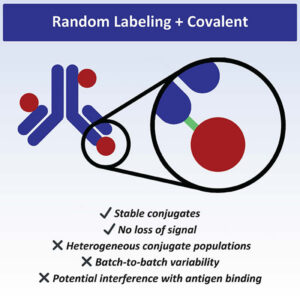
While covalent conjugation is generally preferred for applications requiring maximum stability and reproducibility, many commercially available covalent conjugation technologies involve a trade-off between conjugate stability and control over label attachment.
Traditional covalent conjugation methods, such as amine-reactive lysine labeling, are widely used due to their simplicity and accessibility. However, these approaches generate heterogeneous conjugate populations through random labeling of accessible lysine residues across the antibody. This can lead to several challenges, including:
- Attachment of cargo within or near the antigen-binding region, potentially reducing antibody activity
- Variable degrees of labeling
- Reduced reproducibility and assay consistency
- Limited compatibility with some antibody formulations and buffer components
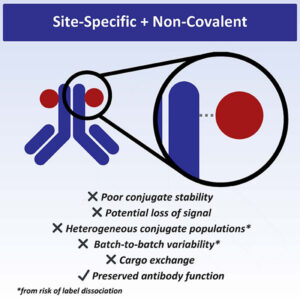
To address these limitations, several site-directed conjugation technologies have been developed. These approaches improve control over label placement, helping to preserve antibody function and generate more uniform conjugates. However, researchers should be aware that these often rely on non-covalent interactions or affinity-based assembly strategies that may not provide the long-term stability of a permanent covalent linkage.
oYo-Link® – Site Specific & Covalent antibody Labeling Technology
AlphaThera’s oYo-Link® Antibody Labeling Technology uniquely combines site-specific labeling with covalent attachment, enabling precise placement of the cargo away from the antigen-binding region while maintaining a permanent linkage between the label and antibody.
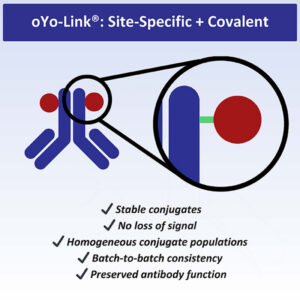
The result is a highly uniform, stable conjugate that delivers the benefits of both site-specificity and covalent conjugation without the compromises typically associated with either approach alone.
oYo-Link offers several additional advantages including:
Rapid Labeling <30 seconds “hands-on” time, 2 hours total. Only 2 steps, mix and illuminate. No need to optimize reaction conditions
- Enabling labeling with small amounts – as little as 1 µg of antibody per reaction
- Enabling labeling in diluted antibody solutions – even those below a concentration of 50 µg/mL
- Ensures no interference with antibody binding
- Uniform product, and consistent, predictable results
- Compatibility with all common buffers – even those that contain storage proteins and amines
Conclusion
As life science research increasingly moves towards highly multiplexed, quantitative, and spatially resolved assays, the limitations of traditional antibody conjugation approaches become more apparent. Covalent conjugation offers significant advantages in terms of conjugate stability, reproducibility, signal quality, and compatibility with demanding experimental workflows.
However, not all covalent conjugation methods are equal. Traditional random labeling approaches can introduce variability through heterogeneous cargo placement and inconsistent conjugate populations, potentially impacting antibody performance and assay reproducibility.
The ideal conjugation strategy therefore combines the stability of covalent attachment with the precision of site-specific labeling. By ensuring a permanent antibody-payload linkage while directing conjugation away from the antigen-binding region, site-specific covalent conjugation can generate highly uniform conjugates with predictable performance characteristics.
For applications such as spatial biology, single-cell analysis, advanced imaging, and therapeutic development, these advantages translate into more reliable workflows, improved data quality, and greater confidence in experimental results.
As assay complexity continues to increase, site-specific covalent conjugation is becoming an increasingly important tool for researchers seeking robust and reproducible antibody conjugates.