













Antibody-oligonucleotide conjugates are foundational tools within spatial biology, single-cell analysis, and targeted diagnostics. As applications become increasingly sensitive and quantitative, relying on a single metric such as degree of labeling (DoL) is no longer sufficient to guarantee performance.
In reality, two conjugates with identical DoL values can behave very differently in an assay. One may deliver a clean, specific signal, while the other produces high background or reduced binding. The difference lies in factors that DoL alone cannot capture: heterogeneity in labeling, purity/residual free oligo, functional integrity, and overall lot-to-lot consistency.
A more complete QC strategy for antibody-oligo conjugates must therefore look beyond DoL alone.
Why DoL alone is not enough
Degree of labeling is one of the most commonly reported metrics for antibody-oligo conjugates. In practice, however, DoL represents only the average oligo-to-antibody ratio (OAR) across the entire population of molecules.
While this average is useful as a high-level indicator, it does not describe how those oligonucleotides are actually distributed across individual antibodies. For example, two conjugate preparations may both report a DoL of 2, yet have very different underlying compositions:
- One may consist predominantly of antibodies attached with two oligos
- The other may contain a broad mixture of unconjugated antibody, lightly labeled, and heavily labeled
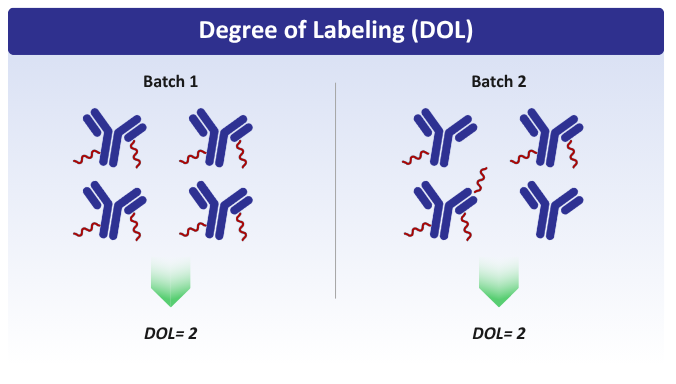
Despite having the same average OAR, these samples can behave very differently in downstream assays, affecting binding, signal intensity, and reproducibility.
This is because DoL combines complex distribution into a single value, masking the presence of under-labeled or unconjugated antibody, the presence of over-labeled species that may impair function, or the overall breadth of the labeling distribution.
To fully understand conjugate performance, it is therefore necessary to look beyond the average and instead characterize the distribution of labeling across the population.
Analytical techniques that help resolve this include:
- Hydrophobic interaction chromatography (HIC) → separates species based on labeling level
- LC-MS → provides detailed insight into molecular distribution
- SEC (Size Exclusion Chromatography) → aggregates vs monomer
- CE-SDS or SDS-PAGE → fragmentation and conjugation shifts
Key takeaway:
DoL is an average (OAR), not a complete description. Understanding labeling distribution is essential for predicting performance and ensuring consistency.
Free Oligo Removal: Purification and Quantitative Analysis
Free oligo can be underestimated because it may be present at low levels and is not always obvious in standard protein-focused assays. However residual unconjugated oligo can be a problem in many downstream applications, particularly in sensitive platforms such as spatial transcriptomics. It can contribute to background signal and compete in hybridization-based assays, ultimately reducing specificity and data quality.
Effective removal of free oligo requires both an appropriate purification strategy and a reliable way to measure success. Techniques such as size exclusion chromatography, ultrafiltration/diafiltration, and anion exchange chromatography are commonly used, each offering a different balance of scalability and resolution.
Common purification approaches include:
- Size exclusion chromatography – gentle but may have limited resolution at scale
- Ultrafiltration/diafiltration – scalable but may not fully separate free oligos
- Anion exchange chromatography – high resolution but requires optimization
Importantly, purification alone is not sufficient and without a quantitative method to assess residual free oligo, it is difficult to determine whether removal has been effective.
Key takeaway:
Effective methods for the removal of free oligo requires both purification and quantitative measurement. Acceptable thresholds (for example, <10% free oligo relative to total oligo content) should be defined based on the tolerance of the downstream assay.
Functional Binding Validation: The reality check
Conjugation chemistry can introduce modifications that affect binding in both subtle and significant ways. Oligonucleotides may create steric hindrance, alter the antibody’s conformation, or modify residues that are critical for antigen recognition.
This is why functional binding validation is essential. It serves as the reality check that confirms whether the conjugate still performs as intended. Simple binding assays such as ELISA can provide an initial readout, while more detailed techniques like surface plasmon resonance can reveal changes in binding kinetics. In many cases, cell-based assays offer the most relevant context, particularly when the final application involves complex biological systems.
Validation approaches:
- SPR/BLI – kinetic analysis (KD, kon, koff)
- Microplate-based assays (ELISA) – scalable binding measurements
- Cell-based validation – Flow cytometry and microplate-based cell assays – higher throughput
What matters most is not absolute performance in isolation, but performance relative to a benchmark. Comparing each conjugated lot to the unconjugated antibody or to a well-characterized reference lot, provides a clear standard for acceptable binding retention. Without this context, it is difficult to determine whether a measured signal reflects retained functionality or loss of activity.
Site-specific oligo-antibody conjugation further supports functional binding by attaching the oligo at a defined location – typically away from the Fab (antigen-binding) region – so the binding site remains intact and accessible. By avoiding random modification of multiple residues, it maintains the antibody’s native structure, reduces aggregation, and ensures a consistent conjugation ratio. It also preserves the oligo’s integrity and orientation, improving its accessibility for hybridization or target interaction. Overall, this controlled and uniform design leads to more reliable and reproducible biological activity compared to heterogeneous, randomly conjugated products.
Key Takeaway:
Define acceptable binding retention (for example, ≥80% of native affinity or signal) based on application-specific requirements. Validation should include a target-negative cell line to confirm that no/minimal non-specific binding. Where possible, use site-specific conjugation approaches/technologies (such as oYo-Link® Oligo Custom) to preserve functional binding.
Defining Meaningful Lot Release Criteria
A robust QC strategy culminates in clear, enforceable lot release criteria. These should reflect both analytical quality and functional performance, ensuring that each batch is fit for its intended use.
Rather than relying on simplistic pass or fail decisions based on a single metric, robust lot release criteria define acceptable ranges across multiple parameters. This approach captures both the physical characteristics of the conjugate and its functional behaviour, providing a more complete and reliable assessment of quality.
Core Release Parameters:
- Identity – Confirm antibody and oligo identity (for example by sequencing or mass spec)
- DoL – Falls within an appropriate range, with both average DoL and conjugate distribution profile reported
- Purity Profile – Aggregates below defined thresholds, minimal unconjugated antibody, controlled heterogeneity
- Free Oligo – Below a defined limit based on application sensitivity
- Functional Binding – Meets predefined acceptance criteria, ensuring sufficient activity is retained after conjugation
- Stability Indicators – Demonstrates stability under storage conditions and, where relevant, robustness to freeze–thaw cycles
What makes these criteria meaningful is that they are grounded in data. Acceptance ranges are typically derived from historical batch performance, method capability, and the observed relationship between these parameters and real assay outcomes. In this way, lot release becomes a predictive tool rather than a retrospective check.
Key takeaway:
Lot release criteria should be multi-parameter and data-driven. Defining clear acceptance ranges across identity, DoL, purity, free oligo, functional binding, and stability ensures consistent lot-to-lot performance and reliable assay results.
Building a Fit-for-Purpose QC Strategy
Not all applications require the same rigor. A research-use reagent may tolerate more variability than a clinical diagnostic yet both require consistency within their intended context. The key is to align QC depth with the sensitivity and demands of downstream use.
In practice, this means evolving from minimal characterization toward a more integrated framework. Early-stage workflows may rely on average DoL and a basic purity check, but as applications scale or become more quantitative, additional layers of control such as DoL distribution analysis, sensitive free oligo detection, and functional benchmarking become essential.
Moving Beyond DoL
Degree of labeling remains an important parameter, but it is only one piece of a much larger picture. A high-quality antibody-oligo conjugate is defined not just by how many oligos are attached, but by how consistently it is produced, how cleanly it is purified, and how well it performs in its intended application.
By adopting a broader QC strategy that treats purity as a profile, rigorously controls free oligo, validates functional binding, and enforces data-driven lot release criteria you’ll ensure that your conjugates deliver reliable and reproducible results. In increasingly sensitive and high-throughput applications, that level of control is not just beneficial, it is essential.
A Practical Framework
| QC Dimension | Minimum Standard | Advanced Standard |
|---|---|---|
| DoL | Average only | Distribution profiling |
| Heterogeneity | SEC monomer % | Multi-method characterization |
| Purity | SEC monomer % | Quantitative functional assay |
| Binding | ELISA | Kinetic + cell-based validation |
| Lot release | Basic thresholds | Application-specific acceptance |
How oYo-Link® Oligo Custom Supports Robust QC Strategies
Many of the QC challenges discussed in this blog, including DoL heterogeneity, residual free oligo, and inconsistent performance, often originate from the conjugation step itself. oYo-Link Oligo Custom helps address these issues upstream, making downstream QC simpler, more reliable, and easier to interpret.
oYo-Link® Oligo Custom enables site-specific conjugation of oligos to the antibody Fc region, resulting in covalent attachment of 1-2 oligos per antibody. This site-specific approach offers key advantages:
- Controlled DoL: oYo-Link is designed to produce a more consistent and predictable number of oligos per antibody. This tighter control reduces heterogeneity, making downstream QC simpler and more interpretable. Instead of needing to manage a wide spread of under- and over-labeled species, the researcher will be working within a narrower, more controlled population
- High conjugation efficiency: Minimizes unconjugated antibody and excess oligo, reducing purification burden and helping to limit residual free oligo
- Avoids interference with binding sites: Site-specific and covalent conjugation at the antibody Fc region ensures no blocking of antigen binding sites and therefore no loss of antibody functionality
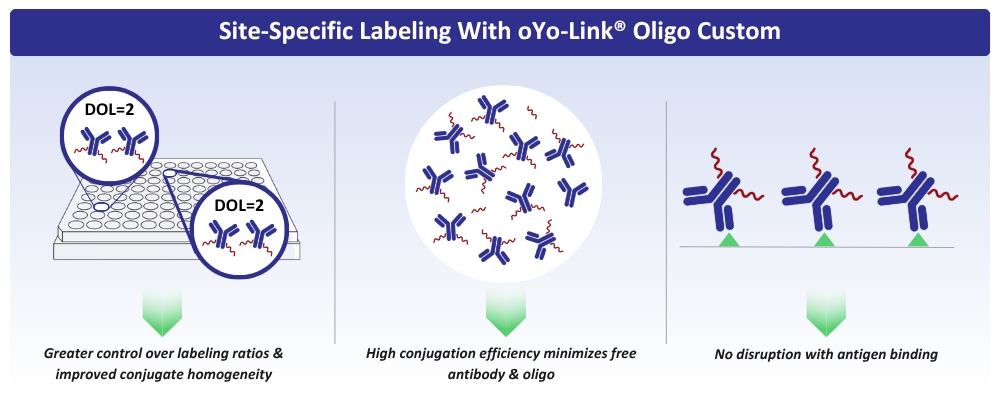
Taken together, these features support a more proactive approach to QC. Instead of relying solely on downstream analytical techniques to detect and manage variability, oYo-Link helps reduce that variability at the point of conjugation. The result is a conjugate that is easier to characterize, more consistent from lot-to-lot, and better aligned with the functional expectations of modern assay systems.
In the context of the broader QC strategy outlined in this blog, this translates to fewer surprises at lot release, tighter control over critical quality attributes, and greater confidence in assay performance.
Discover more about oYo-Link® Oligo here.