



During early ADC prototyping, multiple antibody, linker, and payload combinations must be evaluated to identify the most promising candidates for further development. At this stage, heterogeneity can obscure meaningful insights and therefore the ability to generate uniform conjugates with a well-defined drug-to-antibody ratio (DAR) is critical.
When ADCs are produced as heterogeneous mixtures with variable conjugation sites and broad DAR distributions, it becomes difficult to determine whether differences in efficacy, stability, or toxicity arise from the ADC design itself or from inconsistency in the conjugate population.
Uniform ADCs enable:
- Clearer structure-activity relationships, enabling faster, more accurate design decisions, and avoiding advancing ADCs for the wrong reasons.
- More reproducible in vitro and in vivo data.
- Greater confidence when comparing multiple candidates – ensuring that performance differences reflect design choices rather than conjugate variability.
Without uniformity, promising designs may be overlooked, while suboptimal candidates may advance based on misleading results.
The Role of Defined DAR in ADC Performance
DAR is a key determinant of ADC behavior. Insufficient payload loading can limit potency, while excessive loading can negatively impact stability, pharmacokinetics, and safety. During prototyping, precise control over DAR is essential for understanding these trade-offs.
A defined DAR allows researchers to accurately assess potency and therapeutic window, compare ADC formats on an equal footing, and optimize payload loading without compromising antibody function. In contrast, broad DAR distributions introduce variability that can mask true performance trends and slow optimization.
Limitations of Conventional Conjugation Approaches
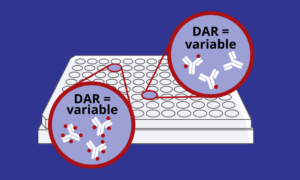
Traditional ADC conjugation methods often rely on random modification of native amino acids, resulting in heterogeneous products with mixed DAR populations.
While these approaches may be suitable for later-stage manufacturing optimization, they pose significant challenges during early discovery including inconsistent conjugate composition, higher antibody consumption per prototype, and reduced throughput when screening multiple ADC designs.
These limitations can constrain the number of prototypes evaluated and increase development risk.
Enabling Better Prototyping Through Controlled Conjugation
Modern prototyping strategies increasingly emphasize controlled, site-specific conjugation to generate homogeneous ADCs with predictable DAR, supporting faster, more informative screening of ADC candidates.
Controlled conjugation enables teams to prototype multiple ADC formats and generate consistent datasets across experiments.
The result is a more efficient discovery process that focuses resources on the most promising ADC designs.
How to Achieve Site-Specific Antibody-Drug Conjugation
oYo-Link® Site-Specific Antibody-Drug Conjugation Reagents
AlphaThera’s oYo-Link® ADC reagents enable rapid prototyping of ADC candidates by allowing site-specific conjugations of drugs to antibodies for use in cancer research applications including targeted cell death and high-throughput screening with cell killing assays.
oYo-Link reagents consist of low molecular weight (~8 kDa), high-affinity antibody-binding domains that possess a photo-crosslinker within their Fc-binding site. Upon illumination with non-damaging Black-light, oYo-Link forms a covalent bond with the antibody. The resulting conjugates possess 1-2 drugs per antibody specifically in the Fc-constant region.
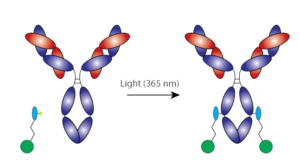
oYo-Link provides 4 main advantages for ADC development & prototyping:
- Uniform, site-specific conjugates with minimal uncertainty: enables precise, site-specific conjugation to the Fc region, ensuring homogeneous ADCs while preserving the antibody binding domain. The resulting conjugates have a well-defined DAR of 1–2, delivering consistent products with predictable efficacy and toxicity profiles.
- No purification of excess drug is required: free oYo-Link–Drug that remains unbound after conjugation is non-toxic to cells, allowing direct progression to cell-killing assays without cleanup. This significantly shortens ADC prototyping timelines and enables greater flexibility for high-throughput workflows.
- Use less antibody: oYo-Link ADC reagents can label as little as 1 µg of antibody, enabling many more experiments from a single antibody or drug batch while reducing costs and supporting high-throughput screening.
- Simple, rapid conjugation: Labeling requires just 30 seconds of hands-on time and 2 steps – mix the oYo-Link-Drug with your antibody and illuminate for 2 hours. No need to purify your antibody prior to labeling as oYo-Link is compatible with all common storage buffers including those containing BSA, Tris and sodium azide.
Learn more and view the full range of oYo-Link® ADC reagents here.