













As antibody-oligonucleotide conjugates are increasingly integrated into quantitative, multiplexed, and sequencing-based assay platforms, there is growing recognition that conjugation architecture is a key determinant of assay performance. Parameters such as oligonucleotide loading, attachment site, and conjugation homogeneity can directly influence signal generation, specificity, and reproducibility.
In this blog we discuss the impact of oligo-antibody ratio (OAR) on assay performance, and how researchers are increasingly turning to site-directed conjugation approaches to achieve better control within their assays.
How important is the oligo-to-antibody ratio (OAR)?
There are situations where OAR may be less critical- for example in qualitative or binary readout assays, or during early-stage feasibility and proof-of-concept studies, where the primary goal is simply to confirm that a signal can be detected.
However, for researchers working with quantitative assays, multiplexed antibody panels, reagent development, or multi-batch and longitudinal studies, the oligo-to-antibody ratio becomes a critical assay design and quality parameter. In these contexts, OAR directly influences assay performance, reproducibility, and data interpretation.
Here’s five ways OAR impacts assay performance:
1. Assay Sensitivity and Signal Control
In applications such as proximity ligation assays, sequencing-based protein detection, or spatial transcriptomics, signal intensity scales with oligo copy number. If the OAR is too low, sensitivity can suffer and low-abundance targets may be missed. If the OAR is too high, signal amplification can become non-linear, increasing background noise and complicating quantitative interpretation.
Controlling the number of oligonucleotides attached per antibody helps ensure that signal strength is robust, predictable, and proportional to target abundance.
2. Preservation of Antibody Binding Performance
Over-conjugation can introduce steric hindrance or alter antibody conformation, reducing specificity or increasing off-target interactions. Maintaining a controlled and moderate OAR helps preserve native antibody binding behavior while still enabling effective downstream detection.
3. Assay Reproducibility & Batch-to-Batch Consistency
For research and diagnostic workflows, assay reproducibility is essential. Variability in oligo-antibody ratio between batches of antibody-oligo conjugates can lead to inconsistent signal intensities that are unrelated to biological differences.
Tight control of OAR improves batch-to-batch consistency, ensuring more reliable experimental results that are easier to compare over time.
4. Data Quality in Multiplexing
In multiplex workflows, OAR variability can compound rapidly and introduce systematic bias across the panel, causing some targets to appear artificially enriched or depleted. This skews relative quantification and can mask true patterns, especially in comparative or clustering analyses.
Consistent OAR across a panel of antibodies supports better cross-target comparability and cleaner downstream data analysis.
5. Manufacturing and Scalability
As antibody-oligonucleotide conjugates transition from laboratory reagents to standardized commercial products, scalability and quality control become increasingly important. Well-controlled OAR simplifies purification, characterization, and release testing, reducing variability and supporting reliable long-term supply.
Limitations in Current Methods for Controlling Oligo-Antibody Ratio
While several commercial oligo-conjugation tools are available, many rely on amine-based chemistries that offer limited control over oligo loading. Because antibodies contain multiple lysine residues distributed across their surface, this approach often results in heterogeneous conjugates with variable OAR.
As a result, site-specific conjugation strategies have gained increasing attention as a way to achieve more consistent and predictable antibody-oligo conjugates. Although commercial services for site-specific labeling are available, they can be costly and may not be accessible for all workflows.
At AlphaThera, we developed the LASIC conjugation method, a cost-effective, site-specific approach that enables the covalent attachment of one to two oligonucleotides per antibody specifically at the antibody Fc region.
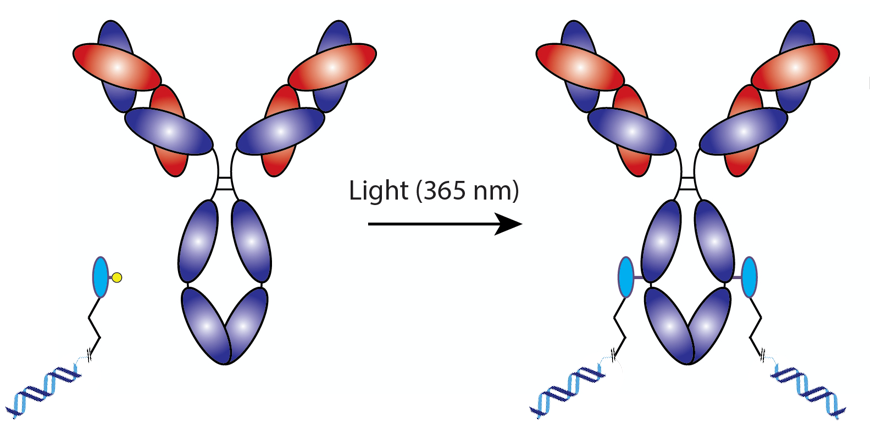
This provides researchers with improved control over both oligo number and attachment location, supporting more reproducible and robust assay performance.
Learn more about our oYo-Link® site-specific oligonucleotide labeling reagents here.
If you prefer to outsource antibody-oligo conjugation, AlphaThera also offers expert oligo labeling services. We can work with as little as 25 µg of antibody and deliver antibodies conjugated to one or two custom oligonucleotides to meet your application requirements. Learn more about our oligo conjugation services here.