

















Antibody conjugation efficiency is often reduced to a single number, however in reality it is a combination of several chemical and functional parameters that together determine whether a conjugation reaction was truly successful.
Metrics such as degree of labeling, reaction yield, and residual free label provide useful information about the chemistry of the reaction. However, they do not always predict how well a conjugated antibody will perform in an assay. To properly evaluate conjugation efficiency, it is important to consider both chemical metrics and functional outcomes.
Below are the key parameters that determine whether a conjugation strategy will deliver reliable assay performance.
Degree of Labeling (DOL) or Drug-to-Antibody Ratio (DAR)
The degree of labeling (DOL) is the most commonly reported measure of conjugation efficiency. It describes the average number of labels attached to each antibody molecule and is typically determined using UV–Vis spectroscopy, mass spectrometry, or similar analytical techniques.
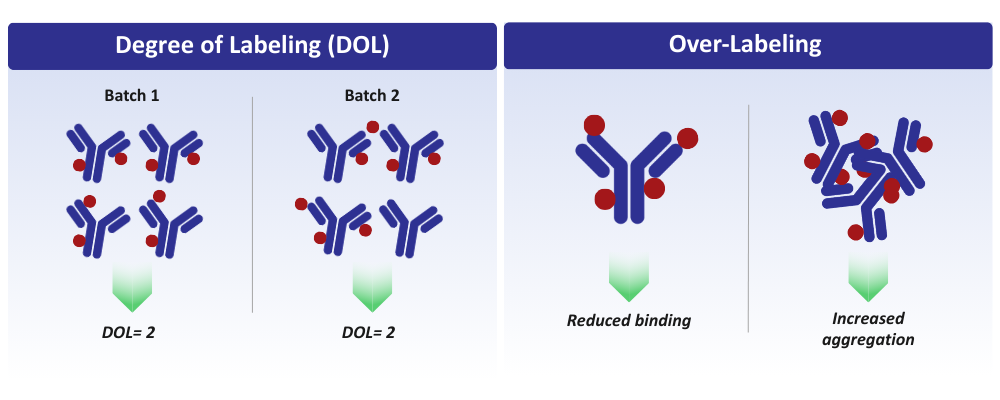
DOL is useful for confirming that conjugation has occurred and for comparing different batches. However, as an average value, it hides the underlying distribution of labels across the antibody population.
Two batches with the same DOL can behave very differently if one contains a relatively uniform population while the other contains a mixture of unlabeled, lightly labeled, and heavily labeled antibodies.
Increasing the DOL beyond an optimal range can also introduce problems. Over-labeling may reduce antigen binding, increase aggregation, and ultimately decrease assay sensitivity.
Conjugate Homogeneity
Conjugate homogeneity refers to how evenly labels are distributed across the antibody population. This parameter has become increasingly important, particularly in quantitative or high-sensitivity assays.
More homogeneous conjugates typically produce more consistent signal behaviour and improved reproducibility. In contrast, highly heterogeneous conjugate populations can introduce variability and reduce assay reliability.
Importantly, homogeneity cannot be inferred from the average DOL alone – it must be evaluated separately.
Free (Unconjugated) Label
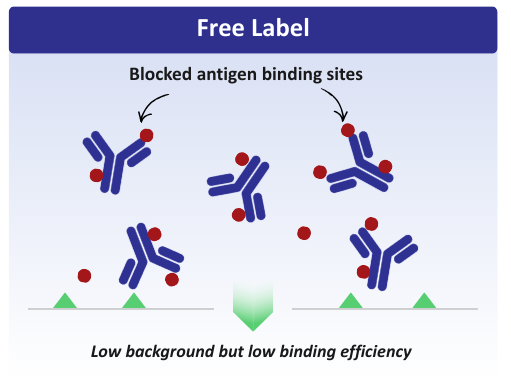
Another commonly used metric is the amount of free, unconjugated label remaining after the conjugation and purification process. Techniques such as size-exclusion chromatography, filtration methods, or fluorescence assays are often used to quantify residual label.
Low levels of free label are generally desirable because unreacted label can contribute to background signal or nonspecific interactions in downstream assays.
However, low free label alone does not guarantee a high-quality conjugate. A sample may contain minimal free label while still performing poorly if the antibody has been over-modified or structurally compromised during conjugation.
Antibody Integrity and Binding Activity
Conjugation chemistry can affect antibody structure, stability, and antigen recognition. For this reason, assessing binding activity is an essential step in evaluating conjugation efficiency.
Methods such as ELISA, flow cytometry, or cell-based assays are commonly used to confirm that antigen affinity and specificity have been preserved.
If conjugation negatively impacts antibody binding, even a reaction with strong chemical metrics cannot be considered successful from an assay perspective.
Functional Assay Performance: The Ultimate Measure
Ultimately, the most meaningful indicator of conjugation efficiency is performance in the final assay. Key performance metrics may include:
- Signal-to-noise ratio
- Sensitivity
- Dynamic range
- Reproducibility
- Stability over time
In many cases, conjugates with moderate labeling levels outperform heavily labeled antibodies once functional performance is evaluated. For this reason, conjugation efficiency is best interpreted in the context of assay results, rather than as a standalone chemical measurement.
A Practical Way to Think About Conjugation Efficiency
Instead of asking whether a conjugation reaction was efficient in absolute terms, a more useful question is whether it was efficient for the intended application. A successful conjugate typically demonstrates:
- An appropriate labeling level
- Minimal residual free label
- A reasonably homogeneous antibody population
- Preserved antigen binding
- Improved assay performance
When these factors are considered together, conjugation efficiency becomes a practical, application-driven concept, rather than a single number to optimize in isolation.
How Site-Specific Antibody Labeling Improves Conjugate Quality
Many of the challenges described above arise from the random nature of traditional antibody conjugation methods, which attach labels to multiple accessible sites across the antibody. Site-specific labeling strategies address these limitations by directing conjugation to defined positions on the antibody structure. This approach can provide several advantages:
- Greater control over labeling ratios
- Improved conjugate homogeneity
- Reduced risk of disrupting antigen binding sites
- More consistent assay performance
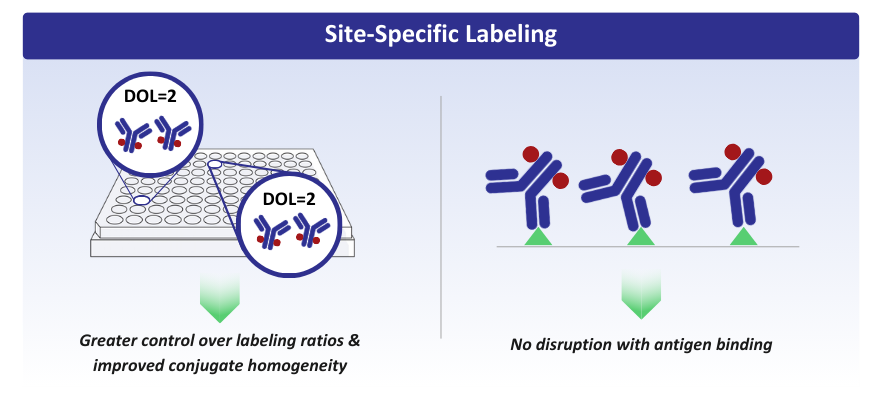
By producing more uniform and predictable conjugates, site-specific labeling technologies can significantly improve the reliability and reproducibility of antibody-based assays. However, many current approaches to site-specific conjugation remain technically demanding. They often require antibody engineering, complex reaction workflows, or specialized reagents, which can limit their accessibility for routine assay development. In addition, some technologies rely on non-covalent interactions between the antibody and the label, which may reduce conjugation efficiency or compromise long-term stability.
oYo-Link® Site-Specific Antibody Labeling Technology was developed to overcome these limitations, providing a fast and straightforward route to covalent, site-specific antibody conjugation.
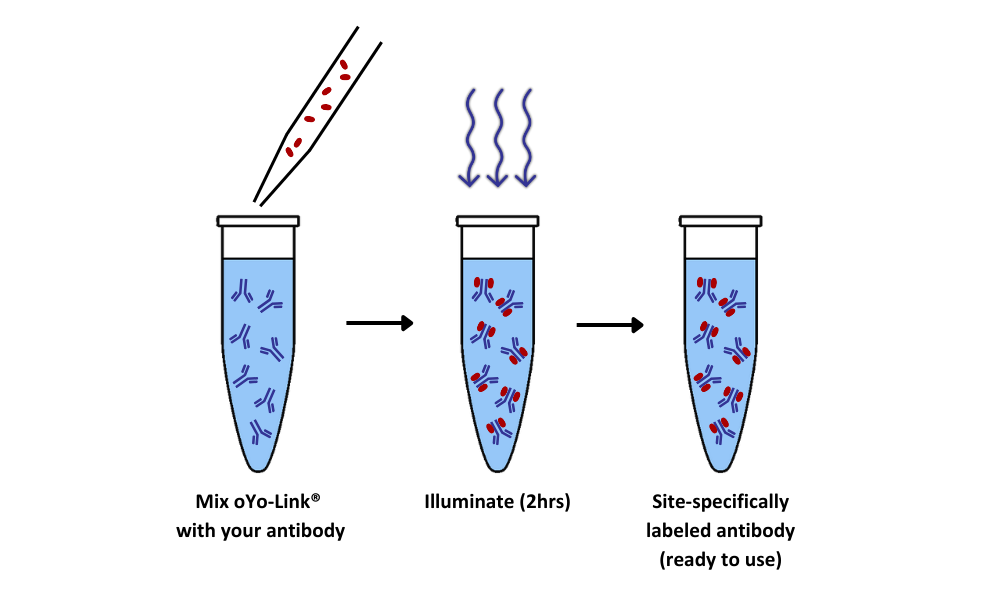
The workflow requires just 2 simple steps – mix and illuminate – allowing researchers to generate stable antibody conjugates in just 2 hours.
oYo-Link® is designed to integrate easily into existing laboratory workflows. Antibodies can be labeled directly in common storage buffers, eliminating the need for time-consuming purification steps prior to conjugation.
The technology is also highly sensitive, enabling efficient labeling with as little as 1 µg of antibody, making it particularly valuable when working with precious or limited samples.
By simplifying site-specific conjugation while maintaining high efficiency and stability, oYo-Link enables researchers to generate more consistent antibody conjugates and improve the performance of their downstream assays.
Learn more about oYo-Link® here.