



















Expanding Multiplex Panel Design with Epitope-Tagged Antibodies
Multiplexing allows researchers to investigate several targets in the same sample, revealing patterns of protein expression, localization and interactions while conserving precious material. However building an effective multiplex panel can be challenging because:
- Using secondary antibodies can limit antibody choice and panel size when primary and secondary antibodies share a host species.
- Directly labeled primary antibodies can overcome this limitation, but may lose the signal amplification provided by secondary antibodies and offer less flexibility when optimizing a panel.
In this blog, we explore these challenges and show how epitope-tagged antibodies can overcome host species limitations while retaining the benefits of indirect signal detection.
The host-species challenge in multiplexing
In conventional indirect assays, an unlabeled primary antibody binds the target of interest before a labeled secondary antibody recognizes the primary antibody.
This approach provides an important advantage whereby multiple secondary antibodies can bind to a primary antibody, helping to amplify the fluorescent signal.
Limitations of primary antibody host species
However in multiplexing assays, multiple primary antibodies are used in the same sample and each needs to be distinguishable by the available secondary detection reagents. As a result, researchers commonly select primary antibodies raised in different host species or belonging to distinguishable antibody subclasses.
As the number of targets increases, these requirements can restrict antibody selection and make multiplex panel design increasingly challenging.
For example, a primary antibody may provide excellent performance against a particular target, but be difficult to incorporate into a panel because another primary antibody from the same host species is also being used. A secondary antibody would be unable to differentiate these two primary antibodies.
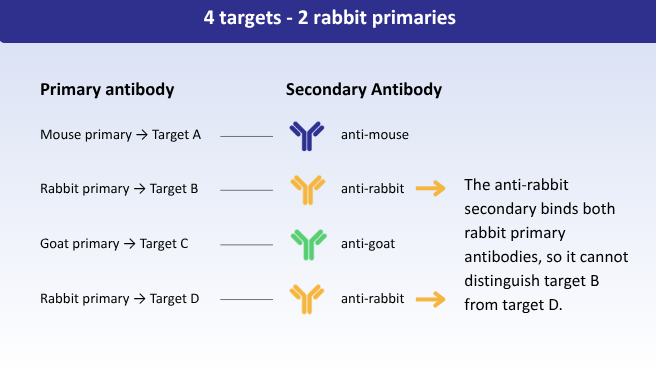
Secondary antibody host species can also affect panel design
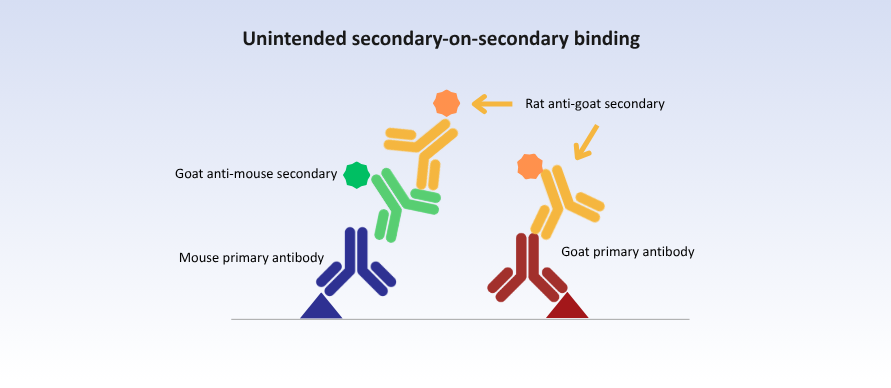
Undesirable cross-reactions can also occur between secondary antibodies. In multiplex assays, a secondary antibody may bind another secondary antibody in the panel as well as the primary antibody it is intended to detect.
For example, if a goat anti-mouse secondary antibody is being used to detect a mouse primary antibody, this precludes the use of a primary antibody derived from a goat host. This is because an anti-goat secondary intended to detect that goat primary antibody would also bind the goat anti-mouse secondary. This would create unwanted signal at the mouse target in the goat detection channel.
Researchers therefore need to consider the host species of both primary and secondary antibodies when selecting reagents for a multiplex panel.
So why not use directly labeled primary antibodies?
A solution to overcome host species limitation is the use of directly labeled primary antibodies.
Because the reporter is attached directly to the primary antibody, multiple antibodies from the same host species can be distinguished without relying on species-specific secondary antibodies.
However, using direct detection for multiplexing introduces some considerations:
1. Signal amplification
Indirect detection can provide signal amplification because multiple labeled secondary antibodies can bind to each primary antibody.
Direct antibody labeling removes this secondary detection step and therefore sacrifices the amplification associated with secondary antibody-based detection. This can be particularly relevant when detecting lower-abundance targets where signal intensity is important.
2. Panel optimization
Fluorophore selection is an important part of developing a multiplex panel. Researchers may need to adjust the fluorophores used to account for factors such as spectral overlap, target abundance and compatibility with other markers in the panel.
When a fluorophore is directly conjugated to the primary antibody, changing the reporter requires using a different conjugate or undertaking another conjugation reaction, incurring additional time and cost of reagents.
Therefore separating target recognition from reporter detection by using secondary antibodies can provide greater flexibility during panel development and optimization.
3. Potential interference with antigen binding
Directly labeling a primary antibody can affect its ability to recognize its target if the label is attached within or near the antigen-binding region. Many conventional antibody labeling chemistries do not provide control over where the label attaches to the antibody, leaving open the possibility that some labels may attach at the binding site and obstruct antigen binding, therefore leading to poor assay performance.
oYo-Link® Antibody Labeling Technology covalently and site-specifically attaches the label to the Fc region of the antibody, therefore ensuring no interference with binding sites, helping preserve antibody function.
More flexibility for multiplex panel design with oYo-Link® Epitope Tag
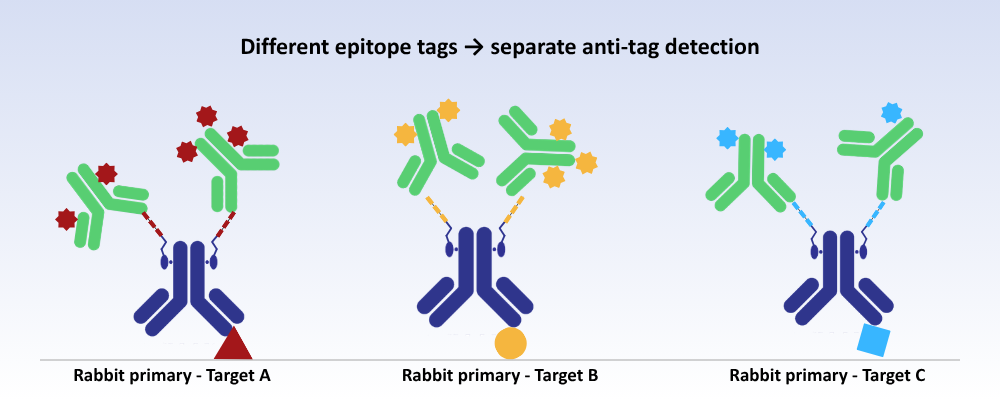
oYo-Link® Epitope Tag offers a modular way to detect multiple primary antibodies from the same host species in a multiplex panel.
oYo-Link® site-specifically attaches 3× tandem-repeat epitope tags to an antibody’s heavy chain, providing up to six copies of the tag per antibody. Each tagged primary can then be detected with a corresponding anti-tag reagent, giving it an identity independent of its host species.
This provides three important advantages for multiplex assay development:
- Flexible panel design – Different tags allow antibodies from the same host species to be distinguished in one sample. Researchers can therefore broaden antibody selection and can choose antibodies based on factors such as specificity and assay performance rather than host species alone.
- Maintained signal amplification – Antibody labeling with oYo-Link Epitope Tag retains the benefits of secondary antibody-based signal detection and amplification while overcoming the host-species constraints associated with conventional secondary detection.
- Greater reporter flexibility during panel optimization – Because the reporter is introduced through the anti-tag reagent, researchers can adjust label combinations during panel optimization without re-conjugating the primary antibody.
Demonstrating same-host-species multiplexing
The ability to independently detect antibodies from the same host species was demonstrated using two rabbit primary antibodies in HeLa cells.
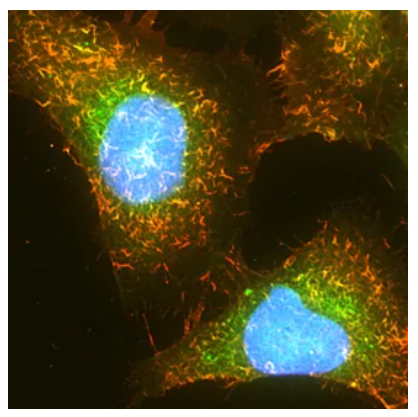
Figure 1. oYo-Link® Epitope Tag multiplexing in HeLa cells. Two rabbit primary antibodies targeting Ezrin and phospho-Chk2 were conjugated with different oYo-Link® Epitope Tags and independently detected using corresponding fluorescent anti-tag secondary antibodies. DAPI nuclear counterstain is shown in blue.
HeLa cells were stimulated with 1 µM camptothecin and stained using:
- Recombinant monoclonal rabbit anti-human/mouse/rat Ezrin antibody (R&D Systems, Cat. # AB72391), conjugated with an oYo-Link® HA Tag
- Polyclonal rabbit anti-human phospho-Chk2 (T68) antibody (R&D Systems, Cat. # AF1626), conjugated with an oYo-Link® DYKDDDDK Tag
The HA-tagged antibody was detected using an anti-HA Alexa Fluor® 594 secondary antibody (red), while the DYKDDDDK-tagged antibody was detected using an anti-FLAG Alexa Fluor® 488 secondary antibody (green). Cells were counterstained with DAPI (blue).
Despite both primary antibodies originating from rabbit, the two targets could be independently detected and visualized within the same sample.
oYo-Link Epitope Tag currently offers 10 tags including His12, DYKDDDDK, V5, S, VSVg, NWS, S1, AU1, AU5 and HSV1.
Antibody labeling is covalent and site-specific, and requires only 30 seconds hands-on time. Just mix oYo-Link Epitope Tag with your antibody and illuminate for 2 hours. oYo-Link is compatible with all common buffers so there is no need to purify your antibody prior to labeling.
Discover more → oYo-Link® Epitope Tag
Epitope Tag Conjugation System Provides Versatility for Multiplex Assay Design:
Learn how Fortis Life Sciences incorporated oYo-Link Epitope Tag with their anti-epitope tag detection antibodies to develop an easy and adaptable system for generating conjugated antibodies to use in multiplex assay → download the poster.