Your cart is currently empty!

- Products
-
oYo-Link® SureLight® APC
$350.00 – $1,875.00 Find out more -
oYo-Link® SureLight® Far Red APC
$375.00 – $2,650.00 Find out more -
oYo-Link® SureLight® PE
$350.00 – $1,875.00 Find out more -
oYo-Link® SureLight® PE-Cy7
$375.00 – $2,650.00 Find out more
-
oYo-Link® Oligo Custom
$450.00 – $1,200.00 Find out more
-
oYo-Link® HRP
$350.00 – $1,875.00 Find out more
-
oYo-Link® Single-Biotin
$300.00 – $1,500.00 Find out more
-
oYo-Link® DM1
$350.00 – $1,875.00 Find out more -
oYo-Link® DM4
$375.00 – $2,650.00 Find out more -
oYo-Link® VcMMAE
$350.00 – $1,875.00 Find out more -
oYo-Link® VcMMAF
$395.00 – $2,900.00 Find out more
-
oYo-Link® Azide
$300.00 – $1,500.00 Find out more -
oYo-Link® DBCO
$300.00 – $1,500.00 Find out more -
oYo-Link® Tetrazine
$300.00 – $1,500.00 Find out more -
oYo-Link® Thiol
$300.00 – $1,500.00 Find out more
-
oYo-Link® Epitope Tag
$300.00 – $2,400.00 Find out more
-
oYo-Link® His12 Tag
$300.00 – $1,500.00 Find out more -
oYo-Link® Single-Biotin
$300.00 – $1,500.00 Find out more
-
oYo-Link® HRP
$350.00 – $1,875.00 Find out more -
oYo-Link® SureLight® APC
$350.00 – $1,875.00 Find out more -
oYo-Link® SureLight® PE
$350.00 – $1,875.00 Find out more
-
LED PX2 Photo-Crosslinking Device
$35.00 – $395.00 Find out more
-
- Products
-
oYo-Link® SureLight® APC
$350.00 – $1,875.00 Find out more -
oYo-Link® SureLight® Far Red APC
$375.00 – $2,650.00 Find out more -
oYo-Link® SureLight® PE
$350.00 – $1,875.00 Find out more -
oYo-Link® SureLight® PE-Cy7
$375.00 – $2,650.00 Find out more
-
oYo-Link® Oligo Custom
$450.00 – $1,200.00 Find out more
-
oYo-Link® HRP
$350.00 – $1,875.00 Find out more
-
oYo-Link® Single-Biotin
$300.00 – $1,500.00 Find out more
-
oYo-Link® DM1
$350.00 – $1,875.00 Find out more -
oYo-Link® DM4
$375.00 – $2,650.00 Find out more -
oYo-Link® VcMMAE
$350.00 – $1,875.00 Find out more -
oYo-Link® VcMMAF
$395.00 – $2,900.00 Find out more
-
oYo-Link® Azide
$300.00 – $1,500.00 Find out more -
oYo-Link® DBCO
$300.00 – $1,500.00 Find out more -
oYo-Link® Tetrazine
$300.00 – $1,500.00 Find out more -
oYo-Link® Thiol
$300.00 – $1,500.00 Find out more
-
oYo-Link® Epitope Tag
$300.00 – $2,400.00 Find out more
-
oYo-Link® His12 Tag
$300.00 – $1,500.00 Find out more -
oYo-Link® Single-Biotin
$300.00 – $1,500.00 Find out more
-
oYo-Link® HRP
$350.00 – $1,875.00 Find out more -
oYo-Link® SureLight® APC
$350.00 – $1,875.00 Find out more -
oYo-Link® SureLight® PE
$350.00 – $1,875.00 Find out more
-
LED PX2 Photo-Crosslinking Device
$35.00 – $395.00 Find out more
-
oYo-Link® SureLight® PE
Rapid, site-specific labeling of compatible antibodies with up to two PE labels. 30 seconds hands-on time, conjugates ready in just 2 hours.
Rapid, site-specific labeling of compatible antibodies with up to two PE labels. 30 seconds hands-on time, conjugates ready in just 2 hours.
oYo-Link® SureLight® PE Antibody Labeling Reagents
For research use only.
oYo-Link® SureLight® PE enables site-specific labeling of compatible antibodies with up to two labels of PE for FACS, flow cytometry, and multimer/tetramer applications.
Simply mix the oYo-Link® SureLight® PE with the desired antibody followed by photocrosslinking for conjugation in 30-sec hands on time, 2 hours total.
Requirements: Photo-Crosslinking Device
Quote or Bulk Orders? Click here.
SureLight® PE is supplied by Columbia Biosciences.
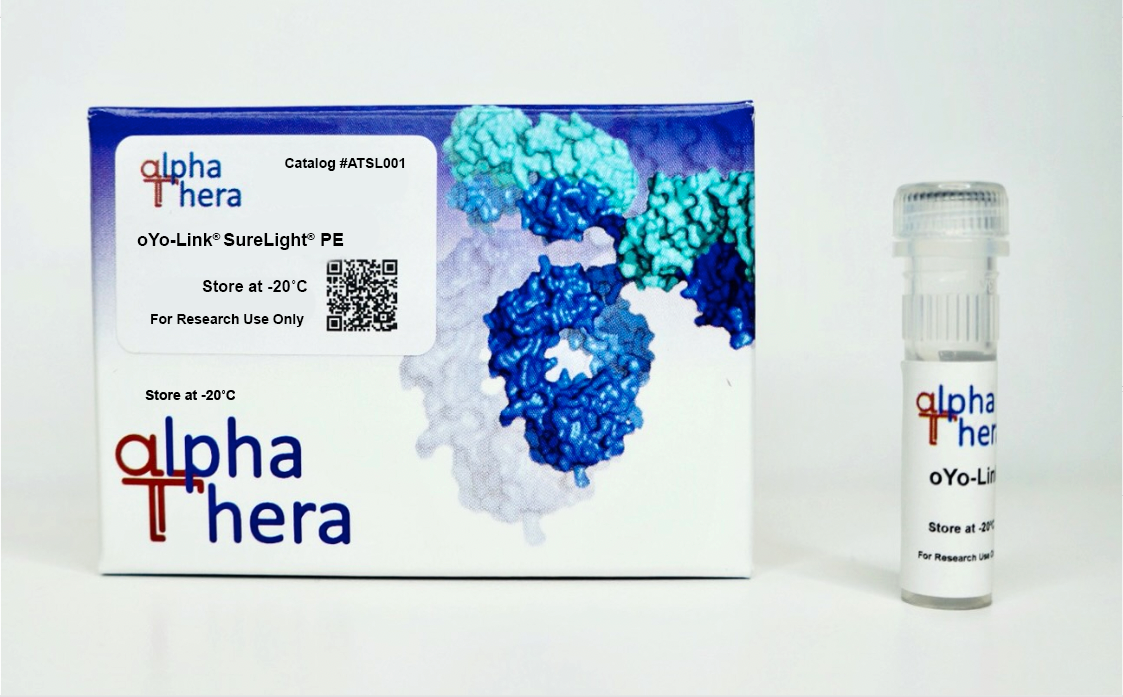
PE is an ultra-bright fluorophore isolated from a group of red photosynthetic pigments found primarily in red algae that emits an intensely bright red-orange fluorescence. PE conjugates are most commonly used for applications requiring high sensitivity such as flow cytometry, ELISAs and microarray assays.
This product is manufactured using SureLight® RPE which is a product of Columbia Biosciences, and uses a proprietary non-destructive cross-linking process that increases the thermal stability while maintaining fluorescent and spectral integrity of the native dye.
Generate antibody-PE conjugates in only 30-seconds hands on time, 2 hours total.
The antibody labeling procedure simply requires mixing oYo-Link® SureLight® PE with the desired antibody followed by photocrosslinking with non-damaging black light (365 nm).
Photocrosslinking can be carried out in most buffers, including those containing amine-containing molecules (e.g. TRIS, glycine) or storage proteins (see Buffer Compatibility Table).
Applications: For fluorescence-based detection. Applications that do not require photostability.
Excitation/Emission: 565nm/574nm
Requirements: To label your compatible antibodies with oYo-Link®, you will need a light source emitting at 365nm (6-10W). Purchase AlphaThera’s LED Photo-Crosslinking Device here, or use a compatible device.
Placing an order: For credit card purchases, proceed with checkout on website. To request a quote click here.
Technical Support: For any technical questions please contact our technical support team here.
Webinar: Simple, fast, site-specific antibody labeling with oYo Link®
Watch our short introduction to AlphaThera’s oYo-Link® site-specific antibody conjugation technology and learn how to streamline your assays with these superior labeling products.
Antibody Conjugation User Manual
Read our antibody conjugation usual manual for instructions on how to easily conjugate your antibody with oYo-Link products.
Demo: oYo-Link® Antibody Conjugation
Find out how to site-specifically label your antibody with just two steps: mix and illuminate. 30 seconds hands-on time, 2 hours total.
oYo-Link® Product Brochure
Download our product brochure
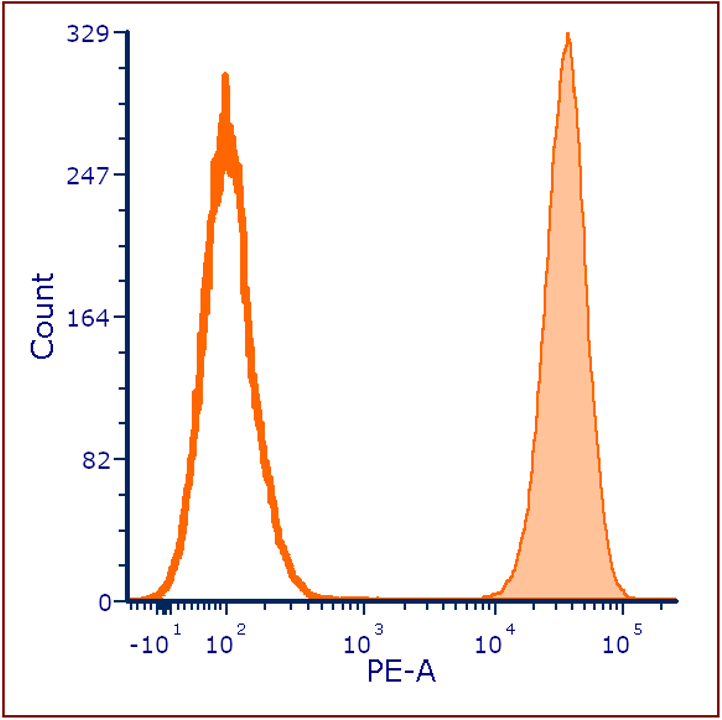
oYo-Link® SureLight® PE Flow Cytometry Data

SPR and BD FACS Canto II, A431 Cells, conjugates tested at 100 ng/test
Specifications:
| Product Name | oYo-Link® SureLight® PE |
| Catalog # | ATSL001 |
| Lot # | See the product spec sheet shipped with the product. |
| Antibody and Buffer Compatibility | View the oYo-Link Antibody & Buffer Compatibility Table here. Note: To label mouse IgG1 antibody, you must order the oYo-Link mIgG1 products, which will only label mIgG1 antibody. |
| Molar Concentration | 33 µM |
| Storage Buffer | 1 x PBS |
| Shipping Condition | This product is shipped as red liquid with cold gel packs. |
| Reconstitution | No reconstitution required. Before opening, briefly centrifuge each tube to ensure that the entire solution is at the bottom. |
| Storage and Stability | The product should be stored at 2-8°C in the dark. Do not freeze. |
| Dye Lot # | RPE3000-24-039 (from Columbia Biosciences) |
| Fluorescence | Peak excitation (approximate): 565 nm Peak emission (approximate): 574 nm |
| Other Notes | Disposal of product should be performed in compliance with all applicable federal, state, and local regulations. This product does not meet hazard classification criteria based on evaluations made by our company under the OSHA Hazard Communication Standard, 29 CFR 1910.1200. |
Will oYo-Link work with my antibody?
Please check the antibody compatibility table. Note: oYo-Link mIgG1 can be used to label mouse IgG1 antibody. Currently, oYo-Link mIgG1 is only available for certain products. Please check the product webpage. oYo-Link mIgG1 only labels mouse IgG1 and is not compatible with other antibodies.
Can oYo-Link be used to label antibodies in the presence of albumin and/or Tris?
Yes, since oYo-Link specifically bind to the heavy chain of IgG, it works in the presence of both albumin and Tris. oYo-Link is compatible with all common buffers. See the full buffer compatibility table here.
If an oYo-Link product has accidentally been left at room temperature for a week, will it still work?
With the exception of oYo-Link DBCO, all oYo-Link products are shipped as white or clear pellets and are very stable. While we recommend cold storage, they will not exhibit any loss of activity if left at room temperature for a week. oYo-Link DBCO must be shipped and stored cold (-20°C) immediately upon arrival, otherwise there will be a loss in activity.
Does AlphaThera offer conjugation service?
Yes. You can find more information about our conjugation services here.
How many oYo-Link labels will be conjugated to each antibody?
For most subclasses and species of antibody, oYo-Link will result in the conjugation of 2 labels per antibody (maximum), one label per heavy chain. For example, ~95% of human IgG and Rabbit IgG will have two labels per antibody. However, there are a few antibodies such as mouse IgG2b and goat IgG, where the conjugation is slightly less efficient. In this case, 60 to 80% of the antibody will be labeled and have a mixture of 0, 1 and 2 labels per antibody. See the antibody conjugation efficiency here
How do I know if oYo-Link was successfully conjugated to my antibody?
Antibody conjugation can be checked on SDS-PAGE gel. An example is present in the supporting data on each product page.
Does 365nm UV illumination damage the antibody and its binding affinity?
The conjugated and unconjugated antibody binding affinities have been tested via both ELISA and cell binding assays and don’t show any difference.
Do I need to remove free oYo-Link after conjugating to antibody?
For most immunoassay applications, purification is not necessary. In our standard recommended protocol, the molar ratio of oYo-Link-to-antibody is 5:1. These conditions ensure that the antibody conjugation efficiency reaches its maximum; however there will be a slight excess remaining in your antibody mixture. This is usually removed during immunoassay washing steps. However, if your application requires high antibody-conjugate purity, please contact us for more information on this process and for a detailed protocol.
What is the lowest amount of antibody that can be labeled by oYo-Link reagents?
We recommend working with at least 1 µg of antibody; however, it is possible that even lower amounts of antibody can be labeled.
Can antibodies that are highly dilute be labeled by oYo-Link reagents?
Yes, antibodies can be efficiently labeled even if diluted to concentrations as low as 50 µg/mL.
oYo-Link® SureLight® PE
- Rapid & easy labeling, only 30 seconds of hands-on time, 2 hours total conjugation.
- Label primary antibodies for direct detection, avoid laborious wash steps and cross-species reactivity.
- Site-specific labeling at the antibody Fc region guarantees no interference with the antigen binding site.
- Site-specific labeling ensures the production of highly consistent conjugates with no requirement for further optimization.
- Label from as little as 1 µg and work with antibody concentrations as low as 50 µg/mL. No need to concentrate or centrifuge your sample prior to labeling.
- Compatible with all common buffers – no need for antibody purification.
Related Products
oYo-Link® SureLight® PE-Cy7
Exc/Emm: 488 nm / 572 nm, 776 nm
Rapid, site-specific labeling of compatible antibodies with up to two PE-Cy7 labels. 30 seconds hands-on time, conjugates ready in just 2 hours.
oYo-Link® SureLight® Far Red APC
Exc/Emm: 713nm/718nm
Rapid, site-specific labeling of compatible antibodies with up to two Far Red APC labels. 30 seconds hands-on time, conjugates ready in just 2 hours.
oYo-Link® SureLight® APC
Exc/Emm: 653nm/660nm
Rapid, site-specific labeling of compatible antibodies with up to two APC labels. 30 seconds hands-on time, conjugates ready in just 2 hours.
oYo-Link® HRP
Applicable for direct conjugation of HRP to primary antibodies for ELISA, IHC & western blotting.
Please Select Epitope Tag Options
4 EPITOPE TAGS: Please select only 4 Tags Below:
Each tag will be able to label the amount of Ab you selected on the previous page.